
McAlder Campus Blog
Called to Armor Up
April 08, 2026
This school year, our students have been walking through the book of Ephesians chapter by chapter. Now we enter the final section, where Paul describes the armor of God. It’s a powerful reminder that as followers of Jesus, we are loved, chosen, and called and that God equips us for the spiritual battles we face each day.
Just like athletes regularly practice in full gear and our theatre students rehearse in costumes before opening night, we need to practice using the armor God gives us. In our household, my husband Jake and I workout and train regularly, and a common question Jake gets is, “are you training for something?” His answer is usually, “Life!” Need to move the piano? Done. Late for a flight? We can run pretty fast if needed! Strength and preparation help us face challenges confidently. The same is true spiritually: We grow stronger when we regularly “train” in God’s truth.
Here’s the armor Paul describes (Ephesians 6:10–17):
The Belt of Truth reminds us that everything starts with knowing God’s truth. It holds the rest of the armor in place and gives us a steady foundation for making wise choices.
The Breastplate of Righteousness protects our hearts and guides not just our actions but also our attitudes. It’s about doing the right thing with the right spirit.
Shoes Fitted with the Gospel of Peace give us a firm footing and help us access peace with God through Jesus no matter what circumstances come.
The Shield of Faith teaches us to place our trust in God’s strength instead of our own. As Romans 8:28 reminds us, God is always working for the good of those who love Him.
The Helmet of Salvation guards our minds with the truth of who we are in Christ: secure, loved, and rescued.
The Sword of the Spirit (God’s Word) is our defense and our strength. Scripture helps us fight lies, but it also helps us honor and uplift others (just as a sword is used not only in battle but also in ceremonies of blessing and recognition!).
We learn from Jesus that we should respond to temptation with Scripture, and this highlights the importance of knowing and practicing God’s Word. On top of that, prayer keeps us connected to Him. In the RightNow media series, Engage about the armor of God, Jennifer Hicks adds, “Prayer is essential to victoriously engaging the enemy. In battle, prayer is the communication system that keeps the soldier connected to the Commander-in-Chief.” (You can check out the entire series here.)
As we enter this month’s chapels and take a deeper look at the armor of God, I want to encourage you and your family. Just like our students practice their sports skills, rehearse their lines in theatre, practice math problems, or train in their musical talents, this month is a chance to practice “wearing” our spiritual armor: to learn it, try it on, and make it part of daily life.
We’re excited to walk through this with our students and continue to help them grow strong, confident, and grounded in God’s truth. I am praying this month will be a meaningful time of learning how to “armor up” together! With the armor of God and a life rooted in prayer, we can face this world with His strength, His peace, and His confidence.
“Finally, be strong in the Lord and in his mighty power. Put on the full armor of God, so that you can take your stand against the devil’s schemes. For our struggle is not against flesh and blood, but against the rulers, against the authorities, against the powers of this dark world and against the spiritual forces of evil in the heavenly realms. Therefore put on the full armor of God, so that when the day of evil comes, you may be able to stand your ground, and after you have done everything, to stand.” (Ephesians 6:10–13, NIV)
RightNow Media Videos for this Month:
Kids:
https://app.rightnowmedia.org/en/content/details/876183
https://app.rightnowmedia.org/en/content/details/374938
Junior High, High School, and Adults:
https://app.rightnowmedia.org/en/content/details/934953
Lastly, this week’s poem was written by junior high student Kylie Barns. Enjoy!
The Echo Between Years
The years unfold like dust and flame,
Each joy and wound without a name.
We learned to run before we knew,
How fast the world could vanish too.
The sky was wide, our hearts were small,
Yet dared to dream beyond it all.
And though we leave, we never go—
The child we were still hums below.
State of the School Annual Report
March 25, 2026
We are preparing to mail out our annual State of the School report, and we are eager to share how God has continued to move in and through our community this year. As we reflect on all He has done, we do so through the lens of our spiritual theme, Called for a Purpose. We believe each student, family, and staff member at CCS has been uniquely called by God, and this year’s story is one of faithfully walking in that calling together.
In this report, you will find updates on the Vision 2035 Goals that serve as the foundation of our district’s growth and direction:
- Student Experience
- Operations
- Community
Throughout each of these areas, we see evidence of God’s purpose unfolding. This year, we have officially reframed Vision 2030 as Vision 2035, which gives us a meaningful opportunity to restate our mission and purpose at Cascade Christian Schools. We are also celebrating many encouraging milestones: becoming a national leader in school safety and security; welcoming our two new Cougar mascots, Creed and C.C.; continued growth in MAP test scores; the addition of the “Big Cat” bus; and the many ways our community has come together to connect and grow. Each of these moments reminds us that when we pursue excellence with Christ at the center, He faithfully multiplies our efforts.
Our dedication to Jesus and our commitment to wisdom, integrity, excellence, and honor continue to shape who we are. CCS is not simply a school district; CCS is a Christ-centered community where students are formed, leaders are developed, and families are strengthened for God’s purposes.
You will receive the printed report in your mailbox soon, and we’ve got a digital version available for you to review online. If you have any questions after reading, we encourage you to reach out to your school leader.
A Call to Serve – IMPACT Term
March 18, 2026
“God has given each of you a gift from his great variety of spiritual gifts. Use them well to serve one another.” —1 Peter 4:10 (NLT)
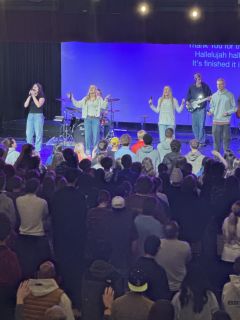
If there was one thing that sets Cascade Christian Schools apart from any other school, it would be IMPACT Term. I-Term for short, this is a week where students are able to use their God-given gifts and talents. We get to go out in our community to I-Terms such as the Tacoma Rescue Mission (which I did my freshman and sophomore years), Ocean Shores (which I did my junior year), and Honduras—which I have the amazing opportunity of being a part of my senior year.
I-Term is truly a wonderful experience because we are not only able to be in fellowship with one another but also able to do God’s work on earth, ministering to others and serving as his ambassadors. We are able to represent both God’s kingdom and Cascade Christian Schools.
Each and every one of us at Cascade Christian has a gift, and during this week we get to use our gifts to glorify God and serve our communities from near, middle, and far! I am looking forward to what God has in store for all of our I-Terms this year.
As we get our hearts ready for a week of service, let us aim to serve with humility, gentleness, and patience as God calls us to in Ephesians 4:2, and let us make the most of this amazing opportunity.
.jpg/Image%20(19)__244x320.jpg)

Kindness, Kintsugi
March 11, 2026
At their cores, the arts of both kintsugi and kindness lie on the same plane: brokenness is a state to be tended to rather than one to be avoided. Originating in the 15th century, kintsugi is a Japanese art form wherein broken pottery is restored with a mixture of lacquer and gold. Rather than disguising the fractures, kintsugi foregrounds them; each break is lined with precious metal. Potters see the potential in pieces that would be otherwise disposed of, and, with gentle touch, the vessels are revived. And as patterns reproduce in nature, so here is another: humanity bears its own fractures—of grief, isolation, and quiet need—but these appear most of all in places we are trained not to look.
Those existing in the margins of society are perhaps the most in need of care yet among the least to receive it. That said, restoration does not need to be manifested in grand gestures, because small kindnesses you can sprinkle and disperse are often more consequential, for all, than many immediately realize. Acts of kindness can enhance their scope deeper and further than assumed, improve one’s own well-being in exceptional ways, and embed themselves into the groundwork of a person’s life for the better.
The Power of Small Acts
Aside from the obvious ways in which service and kindness help others, psychology indicates their effects can prove deeply personal and even be reproduced in others. When you enact “social support”—provided via emotional avenues (e.g., reassurance of worth, affection), instrumental avenues (e.g., material aid), and informational avenues (e.g., advice, guidance)1—you tap into a shared personhood rather than reinforcing the divide our society has formed that sometimes makes it easier to avoid noticing the challenges faced by struggling groups. When, in that moment, the recipient is seen beyond their circumstance and valued despite it, you have the chance to affirm their worth and belonging where others rarely do.
Moreover, since humans are wired to mirror behavior, when someone experiences kindness, they are more likely to pass it on. Hence, a standalone act of social support may multiply into a string of kindnesses, resulting in a ripple effect that forwards positive impacts, small and large, in people’s worlds. Service is not always as plain or concentrated as its optics suggest.
On Kindness and Well-Being
Furthermore, “helping others is helping yourself” is not a hollow phrase. Beyond its effects on others, philanthropy also pours back into the cup of the person participating in it. By redirecting energy spent on yourself to the needs and experiences of others, studies show you can “reduce negative thinking and even [diminish] anxiety or depressive patterns.”2 The effects are not proportionate to the grandness of the act of service either. In fact, the more spontaneous the action, the greater the yield in benefit; seemingly minor, informal gestures like offering to run an errand or cheering a person up can heal in both directions.3
Lacing these kinds of interactions into habits also nurtures “eudaemonic” happiness, which is based in fulfillment derived from purpose.4 Unlike satisfaction from surface pleasures, eudaemonic happiness caters to the welfare of your soul. Additionally, opportunities to see through to alternate lives can bring us outside of ourselves if we let them, and from there, new perspectives can be adopted or understood. Whether lessons learned, pivotal experiences had, or new connections formed, service most always offers substance to the donor too. Fittingly so, kindness is a mutual act at its core.
Compassion as a Lifestyle
For these reasons, compassion is best lived as a practiced way of moving about the world rather than just an occasional indulgence. Service does not have to be a vortex for your time, energy, or resources, nor does it have to be a burden; it does not have to be an extravagant display to be effective or even formal volunteering if such is not suited to you. Though it does require, in any capacity, selflessness and often contact with people in hardship, there is great reward that makes it worthwhile for many. However, if you stitch acts of kindness into your approach to life and establish it as a posture, you may notice “an improved mood, greater life satisfaction, and better physical health”5—directly resulting from you providing for others to reap benefits too. Perhaps most spectacularly, it is also linked to lower mortality rates in older adults, meaning both making serving a habit young or sustaining it later on equals investing in a better future,6 one for you and for those you serve.
Ultimately, though, the standalone greatest reason to model kindness is the model of Jesus himself. As Jesus so beautifully analogized (speaking of cleansing as a metaphor for service), “Now that I, your Lord and Teacher, have washed your feet, you also should wash one another’s feet. I have set you an example that you should do as I have done for you,” (John 13:14–15, NIV). As Christ offered us his firstfruits, laying down even his own life, certainly we can give to others our sweeter produce also, glorifying God by nourishing others.
Also, like Jesus, our commitment is to all; personhood (the imago Dei) is the universal thread that tethers us together, regardless of status, background, or circumstances. To act with compassion, then, is to recognize shared humanity in people, especially those in need or disadvantaged, and choose to respond to it. That may materialize in mentorship through programs, volunteering through organizations, or aiding through community outreach; even still, it can also manifest through small, attentive kindnesses you trail behind your path, for there is power in these, as well. When care is extended in this multitude of ways, we can begin to repair fractures and be involved in a collective restoration. Like kintsugi, compassion is about filling cracks with golden flakes, but it is also about having the heart to do so and to recognize the value in others even when they are fractured.
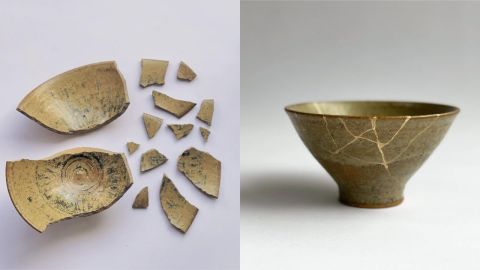
The Art of Kintsugi. Source: instagram.com/tomomikamoshita
Notes
1. Jorunn Drageset, “Social Support” in Health Promotion and Healthcare—Vital Theories and Research [internet], ed. Haugan & Eriksson (Switzerland: Springer, 2021), chapter 11.
2. Ji Suttie, “How Kindness Fits Into a Happy life,” Greater Good Magazine, Winter 2021. https://greatergood.berkeley.edu/article/item/how_kindness_fits_into_a_happy_life
3. Beth Nichol, Rob Wilson, Angela Rodrigues & Catherine Haighton, “Exploring the Effects of Volunteering on the Social, Mental, and Physical Health and Well-being of Volunteers: An Umbrella Review,” Voluntas: International Journal of Voluntary and Nonprofit Organizations 35, no. 1 (2024): 97–128, https://doi.org/10.1007/s11266-023-00573-z.
4. Ibid.
5. Ji Suttie, “How Kindness Fits Into a Happy life,” Greater Good Magazine, Winter 2021. https://greatergood.berkeley.edu/article/item/how_kindness_fits_into_a_happy_life.
6. Ibid.