McAlder Campus Blog
Excellence, Effort, and Heart
October 21, 2026
Elementary: Running Well and Cheering Hard
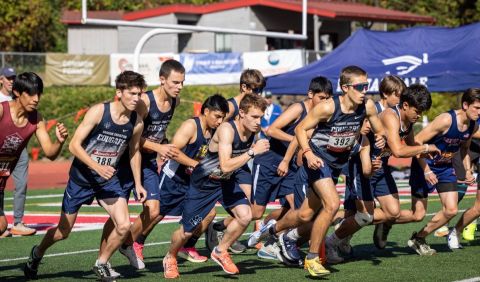
Elementary Athletics is off to an exciting start this fall! More than 300 students in KPrep through grade 6 are participating in fall soccer, while another 35 athletes are competing in cross-country. On Sunday, October 4, 2026, we hosted our third cross-country meet of the season at the McAlder Campus and welcomed more than 400 athletes from 10 schools across the Elementary Nisqually League. Runners from kindergarten through grade six competed on our campus as families and friends lined the course to cheer them on!
Speaking of cheering, our competition cheer team cartwheeled into the season strong. Our 20 cheerleaders have begun practicing, developing their skills, learning routines, and building teamwork as they prepare for their first competition this winter. We look forward to seeing all they accomplish this season!
Junior High: Wins, Records, and a Whole Lot of Heart
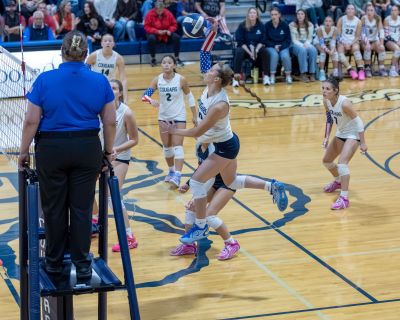
It’s been an exciting fall season for Cascade Christian Junior High Athletics! Our girls volleyball and boys baseball teams are competing hard, consistently winning, and continuing to grow. Athletes in both girls and boys cross-country are putting in the work, setting personal records, and seeing the results of their dedication and perseverance.
Beyond their wins and accomplishments, these student-athletes make us incredibly proud. They work hard, encourage one another, and represent Cascade Christian and Jesus Christ with character and heart. We are thankful for our coaches and athletes who continue to honor God through their effort, attitudes, and actions.
High School: Athletes Had a Ball this Fall
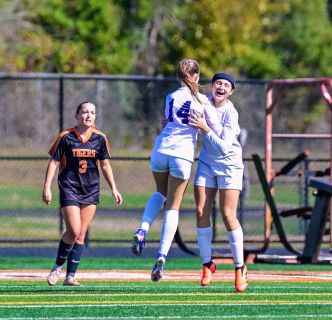
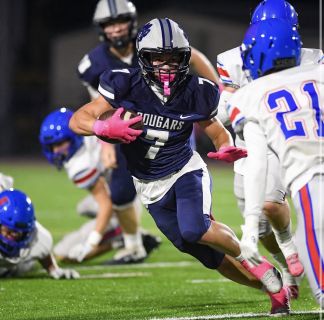
Fall sports are heading into the postseason, revealing the growth of 140 high school student-athletes who dedicated themselves to their teams since mid-August.
Cross-country, cheer, football, girls soccer, boys tennis, and volleyball have been competing throughout the Nisqually League and surrounding areas for opportunities to advance to district and state playoffs. Two programs are making waves statewide, with Cougar volleyball and football both making the top five in the state in recent RPI (Rating Percentage Index) rankings!
Thank you to everyone who has come out to cheer on our Cougars! We look forward to supporting our student-athletes together as postseason competition begins.
To God be the glory. And GO COUGS!
“Glorify the LORD with me; let us exalt his name together.” —Psalm 34:3 (NIV)
Undercover God
October 14, 2026
Understood.
I got it.
Seriously, I heard you the first time.
I know I’m not the only one who gets a little frustrated when people repeat themselves. My pride flares and I even catch myself thinking things like, “I’m such a good listener! How can they not think I was paying attention?”
And yet, the convicting truth is that God can say the same thing repeatedly, can work in my life through various means, and I will still question if I heard him right. God, please just let one more person mention that. God, maybe just one more well-timed song. God, could you give me a dream about it?
There’s a reason Peter looked at the storm and started to drown. Even though he was walking toward Jesus and actively participating in a miracle, he still struggled to have faith and keep his eyes on Jesus.
But when [Peter] saw the wind, he was afraid and, beginning to sink, cried out, “Lord, save me!” (Matthew 22:30)
There’s a reason Thomas needed to feel Jesus’ scars to believe he was truly resurrected, despite the testimony of others, the prophecies, and Jesus’ countless proclamations that he would die and rise again.
The other disciples told him, “We have seen the Lord!” But [Thomas] said to them, “Unless I see the nail marks in his hands and put my finger where the nails were, and put my hand into his side, I will not believe.” (John 20:25)
There’s a reason Gideon requested multiple signs from God in Judges 6 to know God was truly with him.
Let me be clear: Gideon’s behavior does not mean we are justified in demanding signs from God for any given situation. However, his story shows us what blocks our ears from God’s voice: fear, insecurities, mistrusting God. Peter and Thomas also let worries and doubts creep in, and they were both lovingly rebuked by Jesus:
“You of little faith,” [Jesus] said. “Why did you doubt?” (Matthew 14:31)
Then Jesus told him, “Because you have seen me, you have believed; blessed are those who have not seen and yet have believed.” (John 20:29)
God’s patience, grace, and kindness toward us is beyond our comprehension. We can be just like Peter, Thomas, or Gideon, and we can crave multiple signs or some kind of tangible proof of God’s voice and work in our lives. When we do, God doesn’t send fire down from heaven in fury. He doesn’t respond with cold-shouldered silence. He doesn’t even repeat himself as an exasperated sibling, parent, or manager might. No. God speaks to us and repeats himself in the same loving tone you’d expect a good father to use when talking to his child. He shows up for us.
This month we’ve been exploring our new identity in Christ as children of God. I hope you aren’t tired of hearing that truth yet—you are a child of the living God! We don’t have to question whether God is with us or if he’s speaking to us. We know God is acting as a perfect father would: lovingly speaking truth over us and repeating directions as we waver in our course.
Learning to block out the lies of the enemy, the noise of the world, and our own false feelings to hear the still, small voice of God is a discipline that takes practice and a whole lot of help from the Holy Spirit.
My mom often remarks, “Don’t you just wish God could send you an email?” And, of course, life would be much simpler if the Holy Spirit operated a communications system. Imagine: You get a text in the morning from the Holy Spirit telling you to wait five minutes before you leave the house—this will prevent a life-ending collision with another vehicle. However, the reality is we don’t receive any such text. Instead, we run rampant around our kitchen trying to find a misplaced water bottle and leave the house five minutes late, disgruntled and discouraged… but we miss the collision.
I’m not saying every time you get held up is a life-saving act of God, but I want to make the case that God is always at work in our lives, and nothing is too mundane to be part of his sovereign plan. The more we become aware of God’s work in our lives, the easier it becomes to pick his voice out of the rest.
So when a song suddenly speaks to your heart, a pastor’s sermon resonates all too well with your situation, or a Bible verse pops up with a truth you need to hear, don’t discredit those moments or label them as coincidences. God can and will work through the ordinary.
This is the confidence we have in approaching God: that if we ask anything according to his will, he hears us. And if we know that he hears us—whatever we ask—we know that we have what we asked of him. (1 John 5:14)
Finally, be sure to share what God is doing in your life with others. That’s the beauty of being part of a Christian school district: We are constantly surrounded by people who can encourage us in our faith. During this month of generosity, take note of the ways God shows up through simple things like pancakes and extraordinary things like the recent gift toward Fields of Dreams.
God is at work, CCS. I can’t wait to see how he shows up next.
Community That Connects
October 07, 2026
Can you smell the cinnamon in the air? Whether you’re baking pumpkin cookies for a fall bake sale, sipping on your GEN Week hot cocoa, or trying to decide between which of your five CCS sweaters to wear, it’s safe to say that fall is officially here. At CCS, nothing marks October quite like GEN Week and the Homecoming & Alumni Night Football Game!
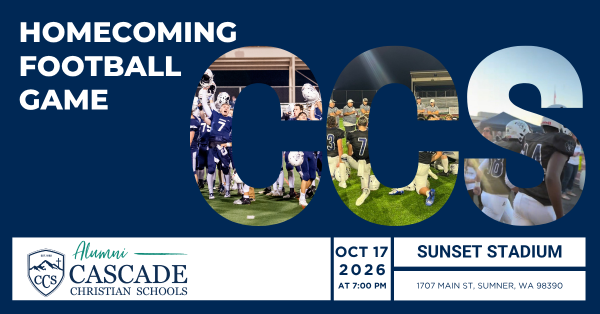
Mark your calendars for the CCS Homecoming Football Game on October 17, 7:00 p.m. at Sunset Stadium, to cheer for our varsity team and honor CCS alumni! Alumni will be greeted with a complimentary drink from alumni-owned business Fortitude Coffee and with some cozy alumni swag designed by CCS family-owned business Teigan & Co.
Between quarters and timeout breaks, we welcome you to bid in the new GEN Week Online Auction to help students stay at the school they love and to improve their campus experience! Bidding is open until October 23.
It’s amazing to see how God can use seemingly simplistic things to bring his children together. In the month of October, CCS families are focusing on our new identity in Christ as children of God. According to Romans 8, God’s children are adopted by him and filled with his Spirit. CCS co-founder, Sue Johnson, recently shared with me that the Holy Spirit is constantly connecting the children of God together to bring about his purposes.
For those who are led by the Spirit of God are the children of God. The Spirit you received does not make you slaves, so that you live in fear again; rather, the Spirit you received brought about your adoption to sonship. And by him we cry, “Abba, Father.” The Spirit himself testifies with our spirit that we are God’s children. —Romans 8:14–16 (NIV)
So, when we’re cheering from the bleachers, bidding on Sue’s garden tour experience, greeting our alma mater, or receiving a GEN Week pancake, my prayer is that we are reminded in these moments that the Lord chose us as his children to be a part of this special CCS community and, ultimately, the body of Christ.
The Final Say: Our New Identity In Christ
September 30, 2026
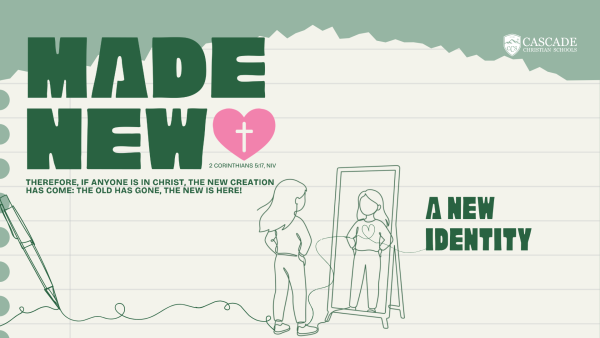
What a great start to the school year! We’re already seeing the ways God is bringing this year’s spiritual theme, Made New, to life in the hearts and lives of our students. This month, we’ll be looking at how being made new involves transformation through having a new identity in Christ.
For many, if not most of us, the question of what defines us—what makes us who we are—is one that is never far from focus. Our highly commercialized culture naturally floods us with opportunities to feel inadequate. Does your daily life measure up to the perfectly crafted image presented by a social media influencer? Of course not! And yet, it’s almost inevitable that we overtly or subtly hear the message, “You’re not good enough.”
The question of identity, then, begins to find its answer not with hope but with a problem. You may think of your identity as being rooted in being an involved parent, a kind person, a hard worker, or even a successful entrepreneur. At the end of the day, though, you know that you do those things imperfectly. When we build our identity on performance in any of these areas, we are setting ourselves up to fail to meet a standard; and the answer we’re left with is to make ourselves better.
In the book of Romans, Paul suggests another way. What if your life was defined not by what you’ve done or what you will do but by the saving work of Jesus Christ? What if you could give up your sense of self-definition and instead place your faith in the one who sees every single one of your imperfections and gave himself as a sacrifice to be with you?
In Romans 3, Paul famously writes, “for all have sinned and fall short of the glory of God, and all are justified freely by his grace through the redemption that came by Christ Jesus. God presented Christ as a sacrifice of atonement, through the shedding of his blood—to be received by faith,” (Romans 3:23–25, NIV). In a strange way, all of the influencers and advertisements are right—you’re imperfect, you don’t really measure up, there are some ways you need to get better.
However, what Paul is saying goes further and offers hope that money, time, and effort can’t buy. You’ve sinned. You fall short. Welcome to being a human. God, through the perfect life, death, and resurrection of Christ, is offering you a gift of redemption, and that gift is received by faith. And when we accept that gift, an identity transformation occurs. I am a flawed father, a flawed husband, a flawed son, a flawed friend, a flawed brother, a flawed teacher, a flawed employee—but by God’s grace, those imperfections don’t have the final say.
Throughout the rest of this month, we will be studying how, throughout Romans, Paul gives us several examples of what this new identity can look like in practice. We’ll see that those who are in Christ are no longer “slaves to sin,” but rather slaves to righteousness (Romans 6:14–16). We’ll see how this identity involves being adopted as children of God and how he is forming us into members of one body in Christ.
Our prayer is that you would join us in study and reflection this month as you continue to embrace an identity that is rooted in the work of Christ and that you would encourage others in your families, neighborhoods, and church communities to do the same.
“So then, just as you received Christ Jesus as Lord, continue to live your lives in him, rooted and built up in him, strengthened in the faith as you were taught, and overflowing with thankfulness.” —Colossians 2:6-7 (NIV)