
Kindness, Kintsugi
March 11, 2026
At their cores, the arts of both kintsugi and kindness lie on the same plane: brokenness is a state to be tended to rather than one to be avoided. Originating in the 15th century, kintsugi is a Japanese art form wherein broken pottery is restored with a mixture of lacquer and gold. Rather than disguising the fractures, kintsugi foregrounds them; each break is lined with precious metal. Potters see the potential in pieces that would be otherwise disposed of, and, with gentle touch, the vessels are revived. And as patterns reproduce in nature, so here is another: humanity bears its own fractures—of grief, isolation, and quiet need—but these appear most of all in places we are trained not to look.
Those existing in the margins of society are perhaps the most in need of care yet among the least to receive it. That said, restoration does not need to be manifested in grand gestures, because small kindnesses you can sprinkle and disperse are often more consequential, for all, than many immediately realize. Acts of kindness can enhance their scope deeper and further than assumed, improve one’s own well-being in exceptional ways, and embed themselves into the groundwork of a person’s life for the better.
The Power of Small Acts
Aside from the obvious ways in which service and kindness help others, psychology indicates their effects can prove deeply personal and even be reproduced in others. When you enact “social support”—provided via emotional avenues (e.g., reassurance of worth, affection), instrumental avenues (e.g., material aid), and informational avenues (e.g., advice, guidance)1—you tap into a shared personhood rather than reinforcing the divide our society has formed that sometimes makes it easier to avoid noticing the challenges faced by struggling groups. When, in that moment, the recipient is seen beyond their circumstance and valued despite it, you have the chance to affirm their worth and belonging where others rarely do.
Moreover, since humans are wired to mirror behavior, when someone experiences kindness, they are more likely to pass it on. Hence, a standalone act of social support may multiply into a string of kindnesses, resulting in a ripple effect that forwards positive impacts, small and large, in people’s worlds. Service is not always as plain or concentrated as its optics suggest.
On Kindness and Well-Being
Furthermore, “helping others is helping yourself” is not a hollow phrase. Beyond its effects on others, philanthropy also pours back into the cup of the person participating in it. By redirecting energy spent on yourself to the needs and experiences of others, studies show you can “reduce negative thinking and even [diminish] anxiety or depressive patterns.”2 The effects are not proportionate to the grandness of the act of service either. In fact, the more spontaneous the action, the greater the yield in benefit; seemingly minor, informal gestures like offering to run an errand or cheering a person up can heal in both directions.3
Lacing these kinds of interactions into habits also nurtures “eudaemonic” happiness, which is based in fulfillment derived from purpose.4 Unlike satisfaction from surface pleasures, eudaemonic happiness caters to the welfare of your soul. Additionally, opportunities to see through to alternate lives can bring us outside of ourselves if we let them, and from there, new perspectives can be adopted or understood. Whether lessons learned, pivotal experiences had, or new connections formed, service most always offers substance to the donor too. Fittingly so, kindness is a mutual act at its core.
Compassion as a Lifestyle
For these reasons, compassion is best lived as a practiced way of moving about the world rather than just an occasional indulgence. Service does not have to be a vortex for your time, energy, or resources, nor does it have to be a burden; it does not have to be an extravagant display to be effective or even formal volunteering if such is not suited to you. Though it does require, in any capacity, selflessness and often contact with people in hardship, there is great reward that makes it worthwhile for many. However, if you stitch acts of kindness into your approach to life and establish it as a posture, you may notice “an improved mood, greater life satisfaction, and better physical health”5—directly resulting from you providing for others to reap benefits too. Perhaps most spectacularly, it is also linked to lower mortality rates in older adults, meaning both making serving a habit young or sustaining it later on equals investing in a better future,6 one for you and for those you serve.
Ultimately, though, the standalone greatest reason to model kindness is the model of Jesus himself. As Jesus so beautifully analogized (speaking of cleansing as a metaphor for service), “Now that I, your Lord and Teacher, have washed your feet, you also should wash one another’s feet. I have set you an example that you should do as I have done for you,” (John 13:14–15, NIV). As Christ offered us his firstfruits, laying down even his own life, certainly we can give to others our sweeter produce also, glorifying God by nourishing others.
Also, like Jesus, our commitment is to all; personhood (the imago Dei) is the universal thread that tethers us together, regardless of status, background, or circumstances. To act with compassion, then, is to recognize shared humanity in people, especially those in need or disadvantaged, and choose to respond to it. That may materialize in mentorship through programs, volunteering through organizations, or aiding through community outreach; even still, it can also manifest through small, attentive kindnesses you trail behind your path, for there is power in these, as well. When care is extended in this multitude of ways, we can begin to repair fractures and be involved in a collective restoration. Like kintsugi, compassion is about filling cracks with golden flakes, but it is also about having the heart to do so and to recognize the value in others even when they are fractured.
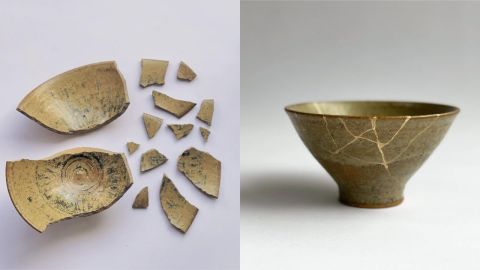
The Art of Kintsugi. Source: instagram.com/tomomikamoshita
Notes
1. Jorunn Drageset, “Social Support” in Health Promotion and Healthcare—Vital Theories and Research [internet], ed. Haugan & Eriksson (Switzerland: Springer, 2021), chapter 11.
2. Ji Suttie, “How Kindness Fits Into a Happy life,” Greater Good Magazine, Winter 2021. https://greatergood.berkeley.edu/article/item/how_kindness_fits_into_a_happy_life
3. Beth Nichol, Rob Wilson, Angela Rodrigues & Catherine Haighton, “Exploring the Effects of Volunteering on the Social, Mental, and Physical Health and Well-being of Volunteers: An Umbrella Review,” Voluntas: International Journal of Voluntary and Nonprofit Organizations 35, no. 1 (2024): 97–128, https://doi.org/10.1007/s11266-023-00573-z.
4. Ibid.
5. Ji Suttie, “How Kindness Fits Into a Happy life,” Greater Good Magazine, Winter 2021. https://greatergood.berkeley.edu/article/item/how_kindness_fits_into_a_happy_life.
6. Ibid.